
Lack of rain - Have we caused our own lack of rain?
This is the question one has to ask oneself if one takes a closer look at the topic of climate, weather and numbers. Even if it may be difficult for some to believe this, the evidence clearly indicates that this is the case. A detailed literature review on this topic can be found here: "The Wind Mania and its Climatic Consequences."
How rain is made:
The basic principle of the global water cycle is based on the fact that water can easily change its state of aggregation. The circulation of water begins in a simplified way at the ocean surface, where large quantities of water evaporate, rise as water vapour into the troposphere and are carried away by the wind. With increasing altitude, it becomes colder, the water vapour condenses and clouds form. The denser the clouds become, the more water they contain. As they continue to rise and cool, rain or snow falls.
According to generally available sources on the water cycle, only about 7-8 % of this water mass (about 40,000 km³ by means of clouds) reaches the mainland, the rest rains down again over the sea. Approximately the same amount of water also flows back into the sea via the rivers.
Water scarcity therefore already occurs when only a small amount less rains on the land than flows off!
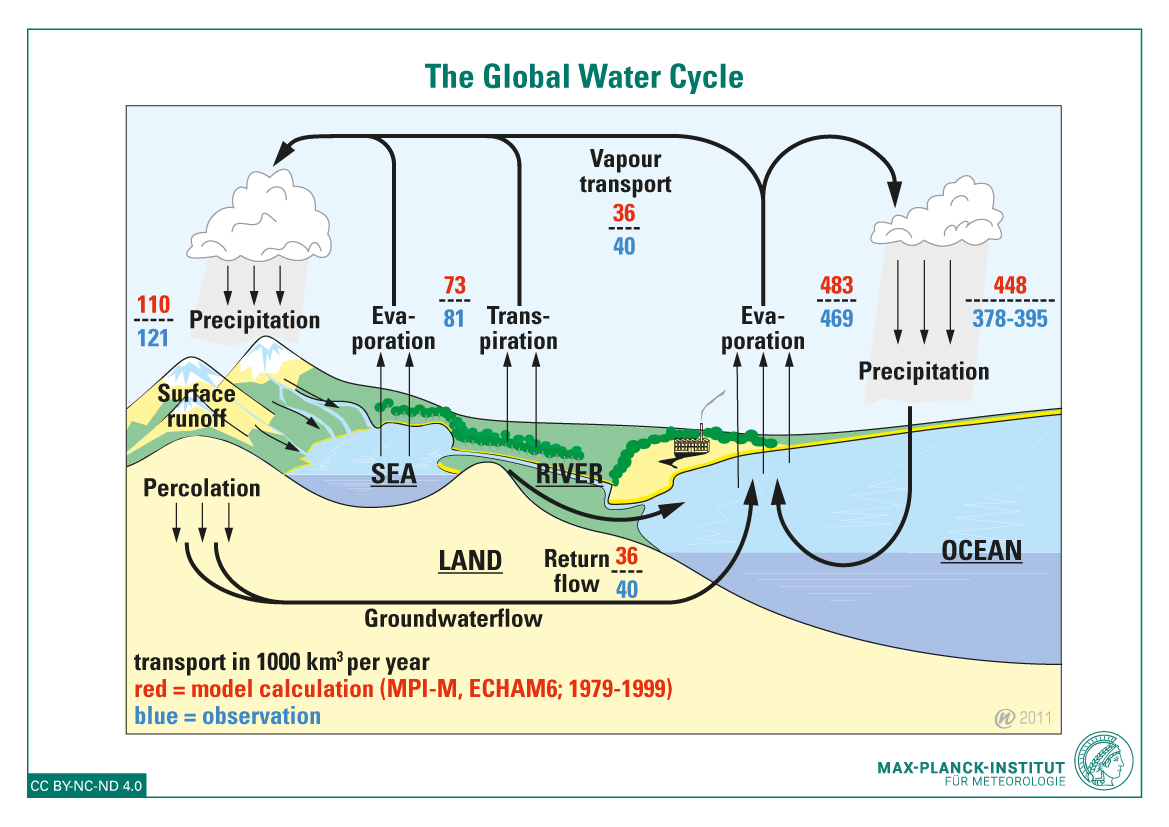
This cycle has functioned stably for centuries and it should be undisputedly true that the wind is the basis for this functioning water cycle. Or should we say that it has represented it?
Wind is created as a result of pressure equalisation between high-pressure and low-pressure weather conditions. This wind carries the water vapour and the water-containing clouds over the mainland and distributes them evenly over a wide area there, provided the wind is free to do its job.
However, the energy of the wind is not infinite, as many people think. If it is deprived of energy by wind turbines, it is slowed down and can no longer fulfil its task - namely the distribution of clouds - as it should.
In the end, it is similar to slowing down the flow of a river by inserting river bricks.
Global wind energy capacity
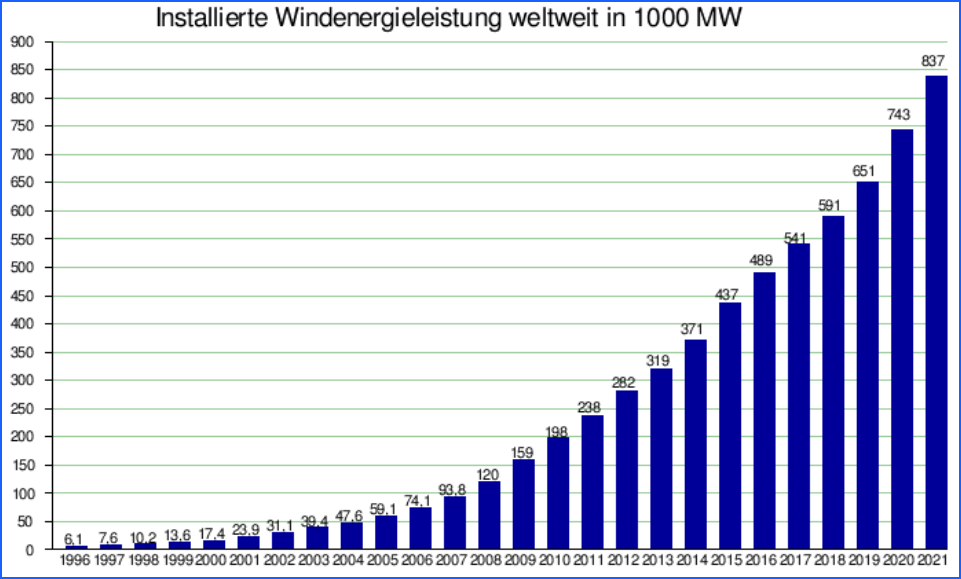
In recent years, the installed wind energy capacity worldwide has doubled to around 837 gigawatts, in Germany to 132 terrawatts. These enormous amounts of energy are missing for the wind to distribute water over the mainland.
However, the wind is not only missing for transport, it is also missing for the distribution of water vapour, which increasingly leads to highly concentrated water masses in the clouds and thus increasingly to downpours during thunderstorms. It is also interesting that the rain clouds in the German Alpine foothills no longer come from the north, but mostly from the west or south over France.
Or is it just a coincidence that the lack of rain and weather extremes have only become so noticeable in recent years, especially where there are many wind turbines, such as in China, Australia, the USA and here in northern Germany?
Example wind power situation in Paderborn
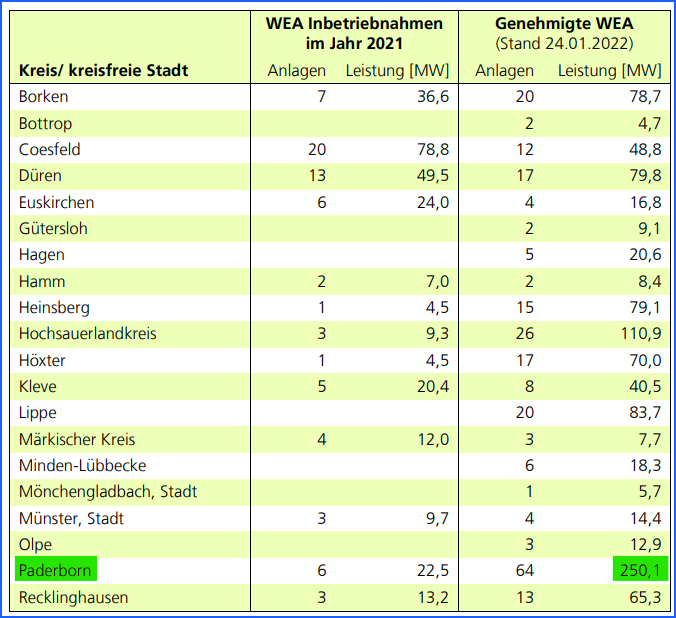
The table below (onbly available in German Language) shows the accumulation of wind turbines in the district of Paderborn. At the beginning of 2022, the approved wind turbine capacity was 250.1 MW.
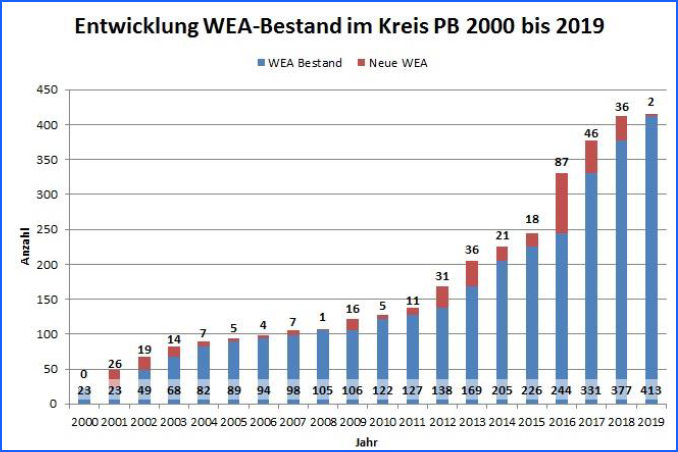
Another particularly meaningful indicator is the installation density or capacity per area. Here, the district of Paderborn is in third place (as of 30.06.2022) in the absolute top field in Germany with 825 kW/km². Higher installation densities are only found in the Schleswig-Holstein districts of Nordfriesland with 1,086 and Dithmarschen with 1,314 kW/km².
Newton's law states: Actio est Reactio!
Obviously, this simple basic knowledge has been replaced by ideology among many politically active people.
In the Paderborn area, there has been a precipitation deficit since 2008 - with the exception of 2017. In total, the annual deficits over 10 years amount to more than one mean annual precipitation.
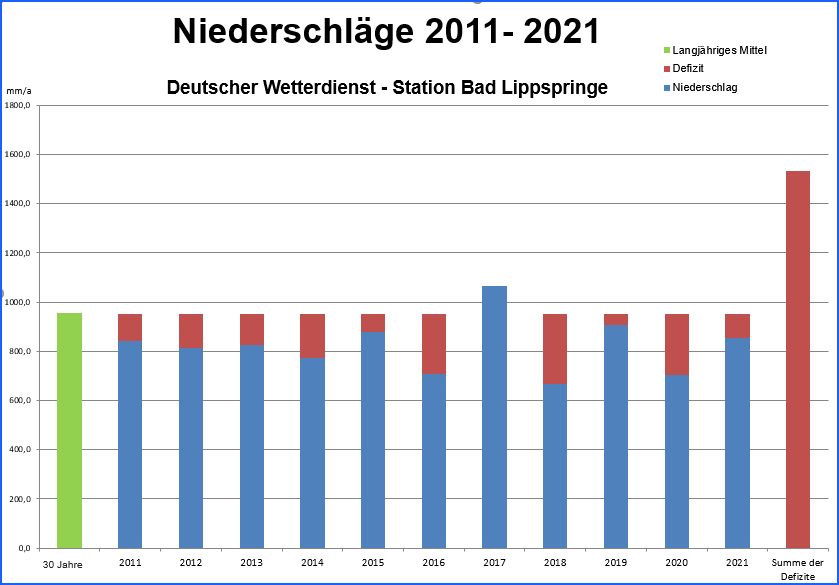
You don't need to be a prophet to be able to estimate what effects the strong increase in wind turbines is likely to have on the development of precipitation in Paderborn and beyond. In any case, not good ones!
Prognosis: The use of wind energy on such a large scale (the end of the line is still a long way off!!!) will in all likelihood turn out to be one of the biggest mistakes of the energy turnaround, as it represents an immense intervention in natural processes, influences the microclimate and causes ground temperatures to rise, because wind also transports accumulated heat away from the cities.
So the question arises: how ecological are wind turbines really, and above all:
Are wind turbines the new nuclear power plants?
In addition to the climatic impacts, the effects of wind turbines on birds and insects are already enormous: around 8 % of the population of buzzards already die annually from wind turbines in northern Germany. In addition, there are 250,000 bats and billions of insects. And by the way, this question also arises with biogas plants, which have become the number one insect killer next to wind turbines due to the extreme green biomass and the lack of flowers on huge areas of land (next to the practice in agriculture of no longer haying, but only baling silage).
And yet the potential of photovoltaics and the thermal use of solar energy are only marginally exploited. There is a huge field of activity slumbering here. Many old heating boilers, which in many houses still produce hot water in summer with oil or gas, could be exchanged or replaced etc., which would mean direct CO2 reduction. In order to realise this, however, the ideological glasses have to be taken off.
A further expansion of wind power, as demanded by many so-called "climate protectors", will therefore probably bring about exactly the opposite of what is wanted.
Conclusion: Wind power should be immediately cancelled as a regenerative energy and further expansion stopped.
The topic of climate is currently playing the leading role in the political debate. Spurred on by the Greens and climate activists and supported by capricious weather conditions, everyone currently sees this topic as a worthwhile field of activity. Yet climate is not something that can be changed in the short term. For the definition climate - weather see here.
How we talk about a topic and which words we use strongly influence our thinking and our emotional world. For this reason, first a short definition of the individual terms and their meaning:
|
Climate change? On the subject of climate, an increase in the average surface temperature of the air is referred to as climate change in the current discussion. Increasing carbon dioxide content in the air is assumed to be the cause. However, this is an unproven hypothesis. A regionally varying increase of the average temperature is visible and undisputed, unlike its hypothetical cause. |
Climate crisis? In the current situation, the ill-considered use of the term climate crisis or climate emergency is the driving force and incentive for activists. In the meantime, political laws are also based more and more on irrational foundations. According to an objective assessment, there is no climate emergency. |
Climate catastrophe? Disasters are unpredictable and usually cannot be reserved. In the context of climate, the term is therefore associated with doomsday and doomsday scenarios. Climate change probably yes, |
That the weather is changing is beyond question. Also, that it is probably anthropogenic effects cannot seriously be doubted and that measures must be taken should be clear to everyone. However, these should be legitimized by research, not opinion.
Which measures should be taken when and where, however, must be thoroughly considered and weighed up. At the moment, far-reaching and in some cases irreversible political decisions are being made which are based exclusively on the opinions of the IPCC and a greenhouse model based purely on solar radiation.
Critics are called deniers and muzzled. The underlying greenhouse model is only an unproven hypothesis and almost certainly wrong, it is not physically possible anyway.
More about this on the other pages in the menu under Climate.
To underline the words "opinions of the IPCC", here is an excerpt from the SYNTHESIS REPORT OF THE IPCC SIXTH ASSESSMENT REPORT (AR6):
"Based on scientific understanding, key findings can be formulated as statements of fact or associated with an assessed level of confidence using the IPCC calibrated language."
This IPCC language is defined as follows:
"Each finding is grounded in an evaluation of underlying evidence and agreement. A level of confidence is expressed using five qualifiers: very low, low, medium, high and very high, and typeset in italics, for example, medium confidence. The following terms have been used to indicate the assessed likelihood of an outcome or result: virtually certain 99–100% probability; very likely 90–100%; likely 66–100%; more likely than not >50-100%; about as likely as not 33–66%; unlikely 0–33%; very unlikely 0–10%; and exceptionally unlikely 0–1%. Additional terms (extremely likely 95–100%; more likely than not >50–100%; and extremely unlikely 0–5%) are also used when appropriate. Assessed likelihood also is typeset in italics: for example, very likely"....
There is no better way to conceal ignorance!
Energy is a collective term for the physical property of being able to do something.
Energy exists in different forms: As e.g. mechanical energy to be able to perform work or as kinetic energy to move objects, we need e.g. electrical energy to surf the internet, to get a lamp to light up or an electric motor to run and thermal energy as heat for heating or cooking.
Without energy, no life and no economic activity is possible. Without energy, no raw materials can be processed and no products or food can be produced. A secure energy supply is therefore essential for people's lives and for the functioning of national economies. A prolonged blackout would be fatal for everyone!
Against this backdrop, the way in which the so-called energy transition has been and is being handled, particularly in Germany and some other countries, appears to be highly negligent.
There is no question that the existing structures must be questioned and, where possible, changed, optimised or replaced. What must be questioned, however, is the speed of the turnaround and the choice of energy sources presented as substitutes for all problems and called renewable energies, such as wind energy and biogas use.
The term renewable energy is a mirage, because energy cannot be renewed, but only transformed: For example, electricity from wind means that the flow energy of the wind is converted into electrical energy by slowing it down.
Both forms of energy have enormous ecological side effects, as will be explained in detail here. First, however, it should be clarified why the demand for energy is constantly increasing and how it is currently being met.
Population development:
Global energy demand is directly linked to technological development and population growth.
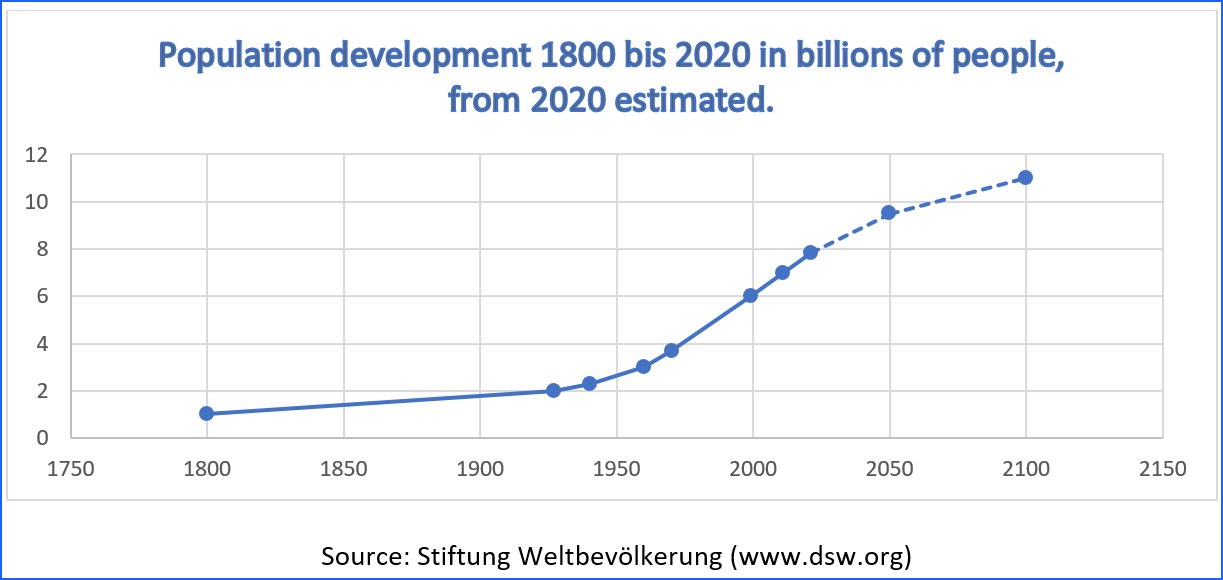
Industrial society has developed over the last 150 years. In the same period, the world's population has grown by a factor of 4-5, from just over 1.2-1.3 billion people to around 8 billion people now. Every second the number grows by around 2.6 people, which corresponds to an annual growth of around 80 million, or roughly the population of Germany.
Fossil energy sources:
The following graph shows the distribution of energy sources: 84.3 % of global primary energy use comes from fossil energy sources! Incidentally, the amount consumed in 2018 was around 584 exajoules or 162,352 terawatt hours (= 162,352,000,000,000 kWh).
Between the year 1990 and the year 2020, global primary energy consumption has increased by about 50%, from about 400 to about 600 exajoules! However, this is not yet reflected to the same extent in the CO2 content of the air.
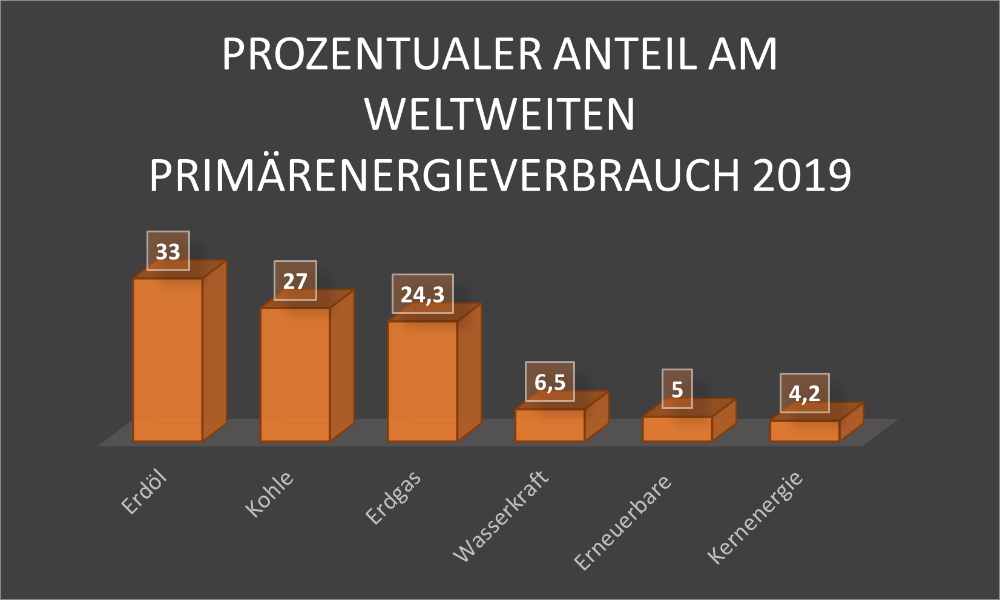
So if we want to change something about the climate in the long term, we first have to pay attention to these figures, or rather facts. We disregard the natural CO2 emissions. If 85 % of primary energy consumption is due to fossil sources, then the next step is to find out where the main consumers are.
As can be seen from the following graph, the massive increase in primary energy consumption - i.e. the increase of 50 % in the last 30 years - took place mainly in Asia and only to a small extent in Europe.
Total energy consumption in Germany fluctuates around 2,500 TWh, which is only about 1.5% of world energy consumption.
The main consumers are industry and transport, each with around 30%. Private households follow with about 25% and trade, commerce and services account for 15%. The relatively constant values over about 30 years are interesting.
By strongly promoting the thermal use of thermal solar energy for hot water production, the consumption of fossil fuels could be reduced quickly and sustainably.
Health is like freedom.
You only feel its value when it is no longer there or when you no longer have it.
While a healthy person usually sees a rosy future - without worries, a sick person often looks sadly, drearily and worryingly ahead and longs for improvement, healing and health.
In most cases - as the Corona pandemic has also just shown - it is hardly possible to influence which group one currently belongs to.
Legal basis:
The Basic Law for the Federal Republic of Germany states in Art 2.
(2) Everyone has the right to life and physical integrity.
But what that means in concrete terms is consciously or unconsciously left open.
The World Health Organisation (WHO), which has taken up the cause of "health for all", is more specific.
The pursuit of "the highest attainable standard of physical and mental health" is one of the economic, social and cultural human rights ("ESC rights") as formulated by the UN in the Social Covenant of 1966 (Art. 12).
(See also www.sozialpakt.info)
If health is defined as a human right, then social systems must also ensure that this is the case. Health systems are thus essential tasks of a state. This includes measures to prevent, treat and combat diseases as well as the economic provision of medical care for all. Health systems are systems of solidarity, because the demands of healthy people are often diametrically opposed to those of sick people.
Against this background, is it morally and ethically justifiable to consider health systems only from the point of view of economic efficiency in terms of profit maximisation?
The massive wave of infections caused by the Covid-19 virus in 2020, which has assumed pandemic proportions, has led to an enormous burden on clinics and clearly demonstrated the weaknesses of the health system.
Whether pandemic or other catastrophes - the systems for health security and health care must be put to the test and set up in such a future-oriented way that both intensive care places and the corresponding nursing staff are available in sufficient numbers or these can be created at short notice.
In addition, it is a social task to ensure that health care systems are economical, open to all people and that the basic right to treatment and medicine is accessible to all people.
However, economic does not mean that health systems should work in a profit-maximising way. Profit maximisation means maximising revenue and minimising expenditure. However, this is exactly what has happened in most clinics over the past decades. More doctors - especially specialists - lead to more billable services. In contrast, nursing staff, who are absolutely essential for patient care and follow-up, have been neglected. In the meantime, the nursing profession has become unattractive for many due to a lack of appreciation, underpayment and overwork, which has led to many positions not being filled for years, or not being able to be filled.
Politicians are now using this state of affairs as an argument to cut beds and close clinics instead of addressing the problems in the nursing professions that have been known for years and solving them for the benefit of the citizens. The main reason for this undesirable development was the introduction of flat rates per case, which took the place of the daily allowance, which was also not optimal. Put simply, hospitals used to be financed by the length of stay, today by the surgical intervention or treatment.
One extreme has been replaced by the other. At the same time, each side also has something good. Working this out and finding a new, patient-friendly billing system is the imperative and the task of the present and the future.
Science creates knowledge!
The scientist is not a person who gives the right answers, but one who asks the right questions. Claude Lévi-Strauss (1908-2009)
Science involves methodical research, the recognition and understanding of causal properties and relationships. People working in science are scientists.
Freedom of research is an essential pillar of science and the scientific community. A large part of research activities is financed by public funds. At the beginning of research is the definition or the concrete question, i.e. the research objective. Research results or partial results are usually published and discussed in established media. In some cases, states are also interested in targeted research activities from a military background - here, as a rule, no publication takes place.
Research also forms the basis for teaching. Research should be largely neutral and open-ended. Research should serve people and be ethically responsible. Research should be critical and also influence or advise politics. Conversely, however, it is also important for politicians to listen to and involve science in their decisions.
Limits of science
Experience shows that research without ethical and moral principles can also be extremely problematic.
Examples from the Third Reich or the simple greed-eats-brains issue, which can be justified not only financially but also in terms of personal reputation (falsification of research results), should only be mentioned here as examples.
High dangers exist today, for example, in genetic engineering (gene scissors), stem cell research and weapons of mass destruction.
A high degree of responsibility must therefore be demanded of researchers. Science and research owe this to the society that finances them.
The Covid-19 pandemic could go down in the history books as an example of a potentially devastating consequence of research activity that got out of control. It is extremely surprising, for example, that the cause of the pandemic cited by the Chinese government was seen as a zoonosis shortly after the outbreak, i.e. the jumping of a virus via an intermediate host to humans, which to date has neither been proven with facts (intermediate host not found) nor scientifically substantiated.
Prof. Dr. Dr. h.c. Prof. h.c. Roland Wiesendanger comes to the conclusion in a study on the coronavirus pandemic that, after evaluating a wide variety of published research reports and sources, there is a great deal of circumstantial evidence to suggest that a laboratory accident at the "Wuhan Institute of Virology" was by far the most likely cause of the corona pandemic.
The study published in early May 2021 can be found at the following link:
https://www.researchgate.net/publication/349302406_Studie_zum_Ursprung_der_Coronavirus-Pandemie
In the institute in question, so-called "gain-of-function" research with coronaviruses was carried out over many years.
Within the framework of this research, coronaviruses were deliberately manipulated with the aim of making them more infectious and dangerous for humans. This research is documented in original publications.
Research with such goals must be rejected on principle!